24
Live planning schemes
Senior debt, stretch senior, mezzanine, JV equity, stabilisation and development exit finance for commercial schemes in Cambridge.
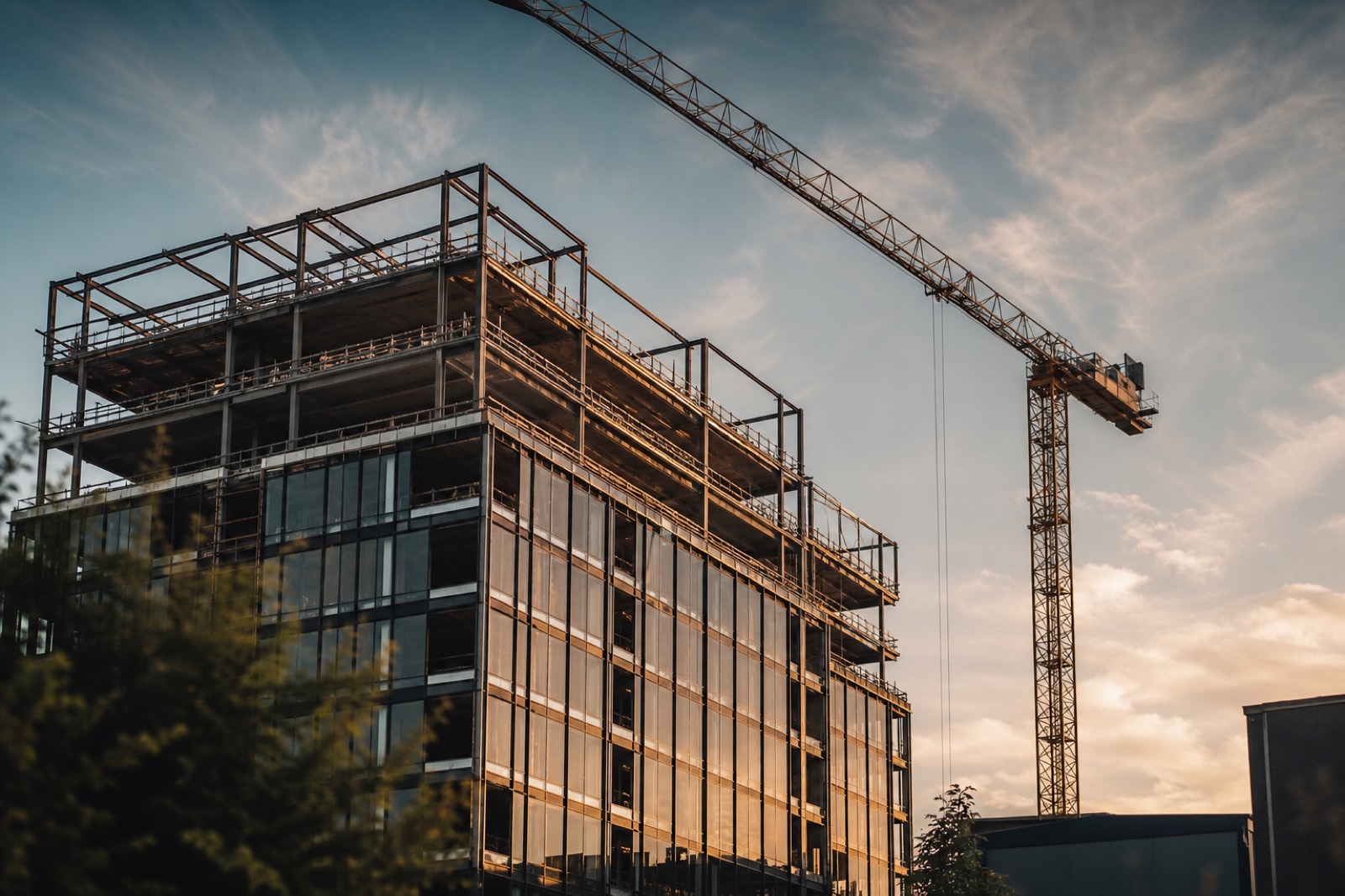
Commercial property development finance in Cambridge funds the land purchase and construction of commercial schemes, from a single conversion to a multi-phase regeneration. We arrange it across Cambridgeshire for developers, investor-developers and operators, structuring the debt and equity a scheme needs and placing it with the lenders that actually back that asset class.
We underwrite a Cambridge scheme on its commercial fundamentals, with the local residential market as a gauge of exit liquidity for any residential element. That market is steady, around 950 residential sales in the past year at a £487,825 median, which helps test the values for the homes in a mixed-use or conversion scheme.
We arrange the whole capital structure for Cambridge commercial schemes. Senior development finance funds the bulk of the build, typically to 65 to 70 percent of cost and 60 to 65 percent of gross development value. Stretch senior and mezzanine finance lift leverage when the appraisal supports it, reducing the equity you commit. JV equity fills the remaining gap for developers scaling beyond their own balance sheet. For operational schemes that let up or trade after completion, such as student accommodation, care homes, hotels or self-storage, stabilisation finance carries the asset from practical completion through to stabilised income. Once the scheme is stabilised or sold, development exit finance refinances it onto cheaper money while units sell or let, releasing equity for the next site in Cambridgeshire.
Each commercial asset class is underwritten on different tests by different lenders, and we arrange finance for all of them in Cambridge and across Cambridgeshire. That covers student accommodation and offices, warehouses and logistics, care homes and healthcare, retail, hotels and leisure, industrial and mixed-use schemes, and the higher-growth classes of self-storage, data centres and life sciences. Knowing which lender backs which sector here, and at what leverage, is the work we do before a scheme ever reaches a credit committee. Local planning records show 167 units in the Cambridge development pipeline with an estimated value of £79,620,700, a measure of current development appetite in the area.
Cambridge is a mid-market location within Cambridgeshire, where development margins depend on disciplined costs and a realistic exit. That profile suits senior development finance with a modest stretch or mezzanine top-up, and it is among the more straightforward backdrops for a lender to underwrite.
Greater Cambridge sits at the western anchor of the Oxford-Cambridge Arc, the corridor central government continues to position as the UK's premier life-sciences cluster. That positioning is colliding with hard constraints. Lab-grade space remains structurally undersupplied, with City Council and Greater Cambridge Shared Planning data showing demand from spin-outs and scale-ups consistently outstripping deliverable floorspace. The knock-on effect is land-value inflation that bleeds straight into residential viability. University-linked tenant demand keeps rents firm in CB1, CB2 and CB4, but graduate and early-career affordability is now a serious political pressure point. The £489,000 median sale price across 953 transactions in the last twelve months sits at roughly twelve times average local earnings, and the year-on-year price change of minus 0.2% suggests buyers have reached a practical ceiling rather than a softening market. For developers, the working assumption should be that headline GDV remains strong on prime postcodes, but build cost, professional fees and the difficulty of assembling viable sites have all moved against schemes that would have penciled three years ago.
Land Registry data shows 953 completed transactions in Cambridge across the trailing twelve months, with median prices settling at £489,000 overall, £800,000 for detached, £560,000 for semi-detached, £496,250 for terraced and £320,000 for flats. The 32% new-build premium against existing stock is one of the steepest in the East of England and reflects how thinly newly-completed product is meeting demand: only 15 of the 953 transactions were new-build. Recent comparables from March 2026 confirm the spread. 53 Bishops Road (CB2 9NQ) sold for £951,200, 11 Plantation Avenue (CB2 9DL) for £980,000, and 29 Musgrave Drive (CB2 0AQ) for £830,000, anchoring the premium end. Mid-market is well represented by 51 Cromwell Road (CB1 3EB) at £515,100, 20 Water Street (CB4 1PA) at £600,000 and 14 Coniston Road (CB1 7BZ) at £525,000. Entry-level activity is dominated by leasehold flats, with 13 Gladeside (CB4 1EL) at £290,000 and Flat 9 Alder Court (CB4 1GX) at £150,000 illustrating the floor.
This residential mix is exit context for the homes within a mixed-use or conversion scheme. It is not a guide to commercial values, which are sector and covenant driven.
| Detached | £799,975 |
| Semi-detached | £560,000 |
| Terraced | £495,000 |
| Flat / apartment | £320,000 |
Source: HM Land Registry residential price-paid data, last 12 months.
| Quarter | Median | Sales |
|---|---|---|
| 2024-Q2 | £485k | 355 |
| 2024-Q3 | £485k | 410 |
| 2024-Q4 | £520k | 415 |
| 2025-Q1 | £485k | 481 |
| 2025-Q2 | £475k | 249 |
| 2025-Q3 | £495k | 343 |
| 2025-Q4 | £490k | 291 |
| 2026-Q1 | £479k | 176 |
Relevant planning activity recorded by Greater Cambridge Shared Planning, a read on competing supply and local development appetite.
Alterations to provide ramped and wheelchair access to both buildings via the existing ground floor covered passageway. Buildings to be joined internally at basement, first second and third floor levels, to provide wheelchair access to the existing lift and pa…
View on the planning portal →S73 to vary condition 2 (Approved plans) of planning permission 25/04941/HFUL (Ground floor renovation and single storey side extension to the existing dwelling. Extension to outbuilding to form new garden studio and associated landscaping to the rear garden)…
View on the planning portal →Change of use and conversion of an existing agricultural building to 4no. dwellinghouses (Class C3) (and for building operations necessary for the conversion).
View on the planning portal →Erection of a single-storey detached timber garden studio to be used for purposes incidental to existing dwelling.
View on the planning portal →Replace existing externally illuminated projection sign with new externally illuminated branded projection swing sign, 1no. A4 sized non illuminated menu box and 1no. non illuminated entrance plaque.
View on the planning portal →Remedial repair works to the river walls at Queens' College, including the repointing of mortar and the replacement of failed/lost masonry.
View on the planning portal →A sample of recent residential transactions across CB2, CB1, CB4, exit context for the residential element of a scheme rather than a guide to commercial values.
| Address | Postcode | Type | Price | Date |
|---|---|---|---|---|
| 3, PORSON COURT | CB2 8ER | Semi-detached | £690,000 | 20 March 2026 |
| 53, BISHOPS ROAD | CB2 9NQ | Semi-detached | £951,200 | 20 March 2026 |
| 39, COCKBURN STREET | CB1 3NB | Terraced | £445,000 | 20 March 2026 |
| 32, WARREN CLOSE | CB2 1LB | Flat / apartment | £402,500 | 18 March 2026 |
| QUEEN EDITH PUBLIC HOUSE, WULFSTAN WAY | CB1 8QN | Other | £190,000 | 17 March 2026 |
| 29, MUSGRAVE DRIVE | CB2 0AQ | Detached | £830,000 | 16 March 2026 |
| 93, ALEX WOOD ROAD | CB4 2EG | Terraced | £380,000 | 16 March 2026 |
| FLAT 9, ALDER COURT, UNION LANE | CB4 1GX | Flat / apartment | £150,000 | 16 March 2026 |
| 61, AINSWORTH STREET | CB1 2PF | Terraced | £435,000 | 13 March 2026 |
| 15, HEADINGTON CLOSE | CB1 9GD | Semi-detached | £450,000 | 13 March 2026 |
The Cambridge equation for developers is now a build-cost-versus-land-value squeeze. Site assembly costs remain elevated, build cost inflation has eased but not reversed, and exit prices have plateaued rather than risen, so the margin for error on appraisals is narrower than it has been in this cycle. Three plays look viable on current numbers. First, small-scale demolition-rebuild and self-build, where the developer effectively monetises the planning consent and avoids debt-heavy speculative builds: the Adams Road, Dudley Road and Caldecote applications all sit in this mould. Second, change-of-use and Class E to C3 conversions in central postcodes, like the Lensfield Road and Huntingdon Road schemes, where existing fabric reduces build cost per unit and central-Cambridge rents support exit value. Third, purpose-built student accommodation and co-living, where the structural undersupply of affordable graduate housing is not in dispute. Senior development finance on these sizes is typically pricing at 9-12% with gearing to around 65-70% LTGDV, with bridging from 0.65% per month covering site acquisition while planning runs.
Twelve applications were live with Greater Cambridge Shared Planning at the date of the briefing, none yet determined, carrying a combined estimated GDV of around £17m across 40 quantified units. The headline scheme is application 26/01691/REM, a reserved-matters submission for 425 residential units on land north of Cambridge North station off Milton Avenue (CB4 0AE), pursuant to the hybrid outline at 22/02771/OUT. That single application materially outweighs the rest of the live pipeline once approved, and its determination timetable is the most important planning event in the city this quarter. Beyond it, the recurring pattern is small-format. Application 26/01721/PRIOR proposes demolition of the EX1 building at Shepreth Research Park, Station Road, and a 25-flat replacement at a notional GDV of £8.1m, a textbook commercial-to-residential reprovision. Application 26/01684/PRIOR on Lensfield Road (CB2 1EN) proposes three Class E to C3 conversions on first and second floors, a small but indicative central change-of-use play. The rest of the list is dominated by single-dwelling self-build, demolition-rebuild and barn conversion proposals across Caldecote, Dudley Road, Adams Road, Fen Ditton and Gamlingay. Approval rate over the twelve-month window stands at zero in this dataset, but that reflects the pipeline being entirely undetermined rather than active refusals.
The Q3 2026 picture turns on a single decision: the 425-unit Cambridge North reserved-matters application. Approval would shift the headline supply story overnight and free up confidence for further submissions in the same corridor. Without it, the pipeline reads as small, fragmented and dominated by self-build. Land values look set to hold, sold prices to drift sideways, and the binding constraint for developers will continue to be planning timetables rather than debt appetite. Lender sentiment toward Cambridge remains strong on residential, PBSA and lab-adjacent commercial, and well-presented schemes with realistic GDV assumptions should find competitive terms through the rest of 2026.
The pipeline carries £17m of GDV across 40 units, but one application accounts for 425 more
Most senior lenders fund up to 65 to 70 percent of total cost, capped at 60 to 65 percent of gross development value, with stretch senior or mezzanine lifting that toward 85 to 90 percent of cost on a strong scheme. The Cambridge exit market, currently steady, informs the gross development value a lender will accept.
We hold more than one hundred lender relationships across banks, challenger banks, debt funds and private capital. The right lender for a Cambridge scheme depends on the sector, the leverage you need and your track record, and we shortlist the desks most likely to back it across Cambridgeshire.
It matters mainly as exit context for the residential element of mixed-use, build-to-rent and conversion schemes. HM Land Registry records a £487,825 residential median in Cambridge over the past year across roughly 950 sales, with flats around £320,000. Commercial values, by contrast, turn on covenant, yield and sector demand, which we assess scheme by scheme.
Yes. We arrange commercial property development finance across the whole of Cambridgeshire and the wider UK, with the same approach: model the capital stack, match the scheme to the lenders that back its sector, and negotiate terms on the developer's behalf.
Send us the outline and we will come back with a view on fundability and likely terms within one working day.