£428k
Residential median (exit context)
Senior debt, stretch senior, mezzanine, JV equity, stabilisation and development exit finance for commercial schemes in Bath.
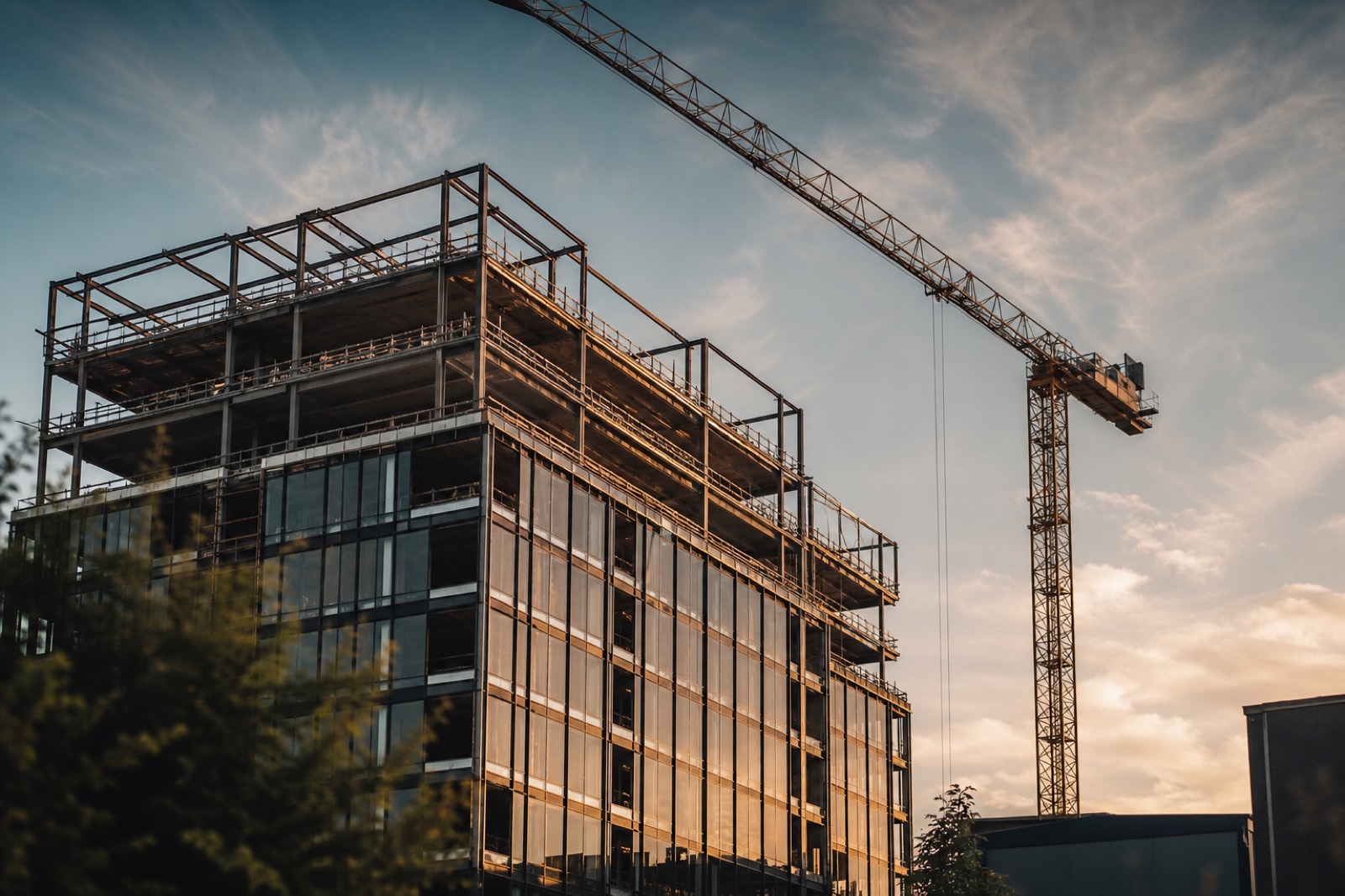
Commercial property development finance in Bath funds the land purchase and construction of commercial schemes, from a single conversion to a multi-phase regeneration. We arrange it across Somerset for developers, investor-developers and operators, structuring the debt and equity a scheme needs and placing it with the lenders that actually back that asset class.
Commercial values turn on covenant, yield and sector demand, which we assess scheme by scheme. The local residential market is useful as exit context for mixed-use and conversion schemes: Bath is steady, with roughly 1,216 residential sales over the past twelve months at a £427,750 median, a read on liquidity for any homes within a scheme.
We arrange the whole capital structure for Bath commercial schemes. Senior development finance funds the bulk of the build, typically to 65 to 70 percent of cost and 60 to 65 percent of gross development value. Stretch senior and mezzanine finance lift leverage when the appraisal supports it, reducing the equity you commit. JV equity fills the remaining gap for developers scaling beyond their own balance sheet. For operational schemes that let up or trade after completion, such as student accommodation, care homes, hotels or self-storage, stabilisation finance carries the asset from practical completion through to stabilised income. Once the scheme is stabilised or sold, development exit finance refinances it onto cheaper money while units sell or let, releasing equity for the next site in Somerset.
Each commercial asset class is underwritten on different tests by different lenders, and we arrange finance for all of them in Bath and across Somerset. That covers student accommodation and offices, warehouses and logistics, care homes and healthcare, retail, hotels and leisure, industrial and mixed-use schemes, and the higher-growth classes of self-storage, data centres and life sciences. Knowing which lender backs which sector here, and at what leverage, is the work we do before a scheme ever reaches a credit committee.
Bath is a mid-market location within Somerset, where development margins depend on disciplined costs and a realistic exit. That profile suits senior development finance with a modest stretch or mezzanine top-up, and it is among the more straightforward backdrops for a lender to underwrite.
Bath remains one of the most price-resilient secondary markets in the South West, and the latest Land Registry data underlines why. The median across 1,218 sales settled at £427,750, with detached stock running at a £700,000 median, semi-detached at £475,000, terraced at £420,000 and flats at £303,000. That terraced figure is the structurally important one: Georgian and Victorian terraces dominate the housing fabric inside the World Heritage boundary, and they are trading at near-detached prices in many comparable English cities. Year-on-year growth of 0.4 percent reads as flat, but in a market that has absorbed two rounds of stamp duty change and a sharp rate cycle, holding the line at this level is the story. The wider point for developers is that Bath does not have a volume problem. It has a stock problem. With conservation area designation, listed building density and UNESCO heritage status all pressing on what can physically be delivered, supply remains structurally tight and that is what keeps the pricing floor where it is.
Recent transactions show the spread that defines Bath as a development market. At the upper end, 3 Paddock Woods (BA2 7AD) sold detached freehold for £885,000 in mid-March 2026 and 15 Richmond Place (BA1 5PZ), a terrace in the Lansdown conservation area, achieved £820,000. In the family-home bracket, 48 Ringwood Road (BA2 3JL) traded at £510,000 and 4 Charlcombe Rise (BA1 6LA) at £650,000. The Georgian and Victorian flat market is equally active and price-stratified: Apartment 3 at Brompton House, St Johns Road (BA2 6PT) sold for £415,000, while Flat 1 at 17 Daniel Street (BA2 6NB), a leasehold conversion in a Bath stone townhouse, achieved £347,500. Entry-level terraced stock in BA2 1 and BA2 3 still trades in the £249,500 to £400,000 range, which is where small developers competing on refurbishment margin tend to operate.
This residential mix is exit context for the homes within a mixed-use or conversion scheme. It is not a guide to commercial values, which are sector and covenant driven.
| Detached | £700,000 |
| Semi-detached | £475,000 |
| Terraced | £420,000 |
| Flat / apartment | £304,000 |
Source: HM Land Registry residential price-paid data, last 12 months.
| Quarter | Median | Sales |
|---|---|---|
| 2024-Q2 | £455k | 437 |
| 2024-Q3 | £448k | 550 |
| 2024-Q4 | £412k | 590 |
| 2025-Q1 | £425k | 632 |
| 2025-Q2 | £412k | 310 |
| 2025-Q3 | £446k | 433 |
| 2025-Q4 | £430k | 399 |
| 2026-Q1 | £403k | 204 |
A sample of recent residential transactions across BA1, BA2, exit context for the residential element of a scheme rather than a guide to commercial values.
| Address | Postcode | Type | Price | Date |
|---|---|---|---|---|
| 2, ASHLEY TERRACE | BA1 3DP | Terraced | £260,000 | 30 March 2026 |
| 21, HERBERT ROAD | BA2 3PP | Terraced | £400,000 | 27 March 2026 |
| 48, RINGWOOD ROAD | BA2 3JL | Terraced | £510,000 | 25 March 2026 |
| 35, SOUTHDOWN ROAD | BA2 1HJ | Terraced | £450,000 | 20 March 2026 |
| FLAT 8, BEAUMONT HOUSE, COLLEGE ROAD | BA1 5RY | Flat / apartment | £390,000 | 20 March 2026 |
| 129, SHERIDAN ROAD | BA2 1RA | Terraced | £249,500 | 20 March 2026 |
| 2, ROSE COTTAGES, ST MICHAELS COURT | BA2 7EZ | Terraced | £665,000 | 20 March 2026 |
| 7, ST KILDAS ROAD | BA2 3QJ | Terraced | £376,000 | 19 March 2026 |
| FLAT 7, SUTCLIFFE HOUSE, LONDON ROAD | BA1 6AJ | Flat / apartment | £460,000 | 18 March 2026 |
| 15, CORONATION AVENUE | BA2 2JT | Terraced | £422,000 | 17 March 2026 |
The Bath market does not reward the volume housebuilder model. It rewards three distinct strategies. First, heritage refurbishment of Georgian and Victorian terraces, where listed building consent and conservation-area planning are the binding constraints and where finished GDVs in BA1 and BA2 7 postcodes routinely exceed £800 per square foot. Second, small-site conversions of period townhouses into compliant apartment schemes, where the median flat price of £303,000 sets a floor but where well-specified one and two-bed units in central BA1 and BA2 6 are clearing £400,000 to £450,000. Third, change of use opportunities on office and commercial stock in the city centre fringe, where permitted development still applies but where Bath's tight design code adds material cost. We are typically quoting senior development finance at 9 to 12 percent on facilities supporting 65 to 70 percent LTGDV for these structures, with bridging from 0.65 percent per month where acquisition speed matters on listed-building lots.
Idox planning data for Bath & North East Somerset is not currently captured in our weekly pull, so we cannot publish a verified live pipeline for the city itself. The wider Somerset picture from neighbouring authorities is instructive. Across the legacy Mendip district portal that covers Wells, Frome and Glastonbury, we are tracking 36 relevant residential applications totalling 999 pending units and an aggregate estimated GDV of around £317 million as at 20 May 2026. None of those applications have yet received decisions in our current dataset, which means the regional approvals pipeline is loaded but still moving slowly through committee. The character of that pipeline is also worth noting: a single 180-unit Stratton on the Fosse scheme and a 90-unit Common Moor Drove reserved matters application in Glastonbury account for the bulk of the unit count, with the remainder dominated by single-dwelling rural conversions, small barn-to-residential changes of use and self-build plots. The shape of the Mendip pipeline mirrors what we see in B&NES anecdotally: very few large strategic sites, a long tail of small heritage-led conversions, and a planning system that rewards developers who understand how to engage with conservation officers from day one.
We expect Bath transaction volumes to stay in the 1,150 to 1,250 range for the rest of 2026, with the median holding above £425,000 unless rates move sharply. The constrained supply picture, only two new builds in twelve months, means the pricing floor is unlikely to soften materially. The Q3 question is whether B&NES planning approvals accelerate to match the pipeline now building across neighbouring Mendip, where 999 units sit waiting for decisions. For developers active in the city, the strategic priority is securing pre-application engagement on heritage-led schemes now, ahead of a likely Q4 push on conservation-area refurbishment as rates settle.
Bath does not have a volume problem; it has a stock problem, and that is what keeps the pricing floor where it is.
Most senior lenders fund up to 65 to 70 percent of total cost, capped at 60 to 65 percent of gross development value, with stretch senior or mezzanine lifting that toward 85 to 90 percent of cost on a strong scheme. The Bath exit market, currently steady, informs the gross development value a lender will accept.
We hold more than one hundred lender relationships across banks, challenger banks, debt funds and private capital. The right lender for a Bath scheme depends on the sector, the leverage you need and your track record, and we shortlist the desks most likely to back it across Somerset.
It matters mainly as exit context for the residential element of mixed-use, build-to-rent and conversion schemes. HM Land Registry records a £427,750 residential median in Bath over the past year across roughly 1,216 sales, with flats around £304,000. Commercial values, by contrast, turn on covenant, yield and sector demand, which we assess scheme by scheme.
Yes. We arrange commercial property development finance across the whole of Somerset and the wider UK, with the same approach: model the capital stack, match the scheme to the lenders that back its sector, and negotiate terms on the developer's behalf.
Send us the outline and we will come back with a view on fundability and likely terms within one working day.