£156k
Residential median (exit context)
Senior debt, stretch senior, mezzanine, JV equity, stabilisation and development exit finance for commercial schemes in Bradford.
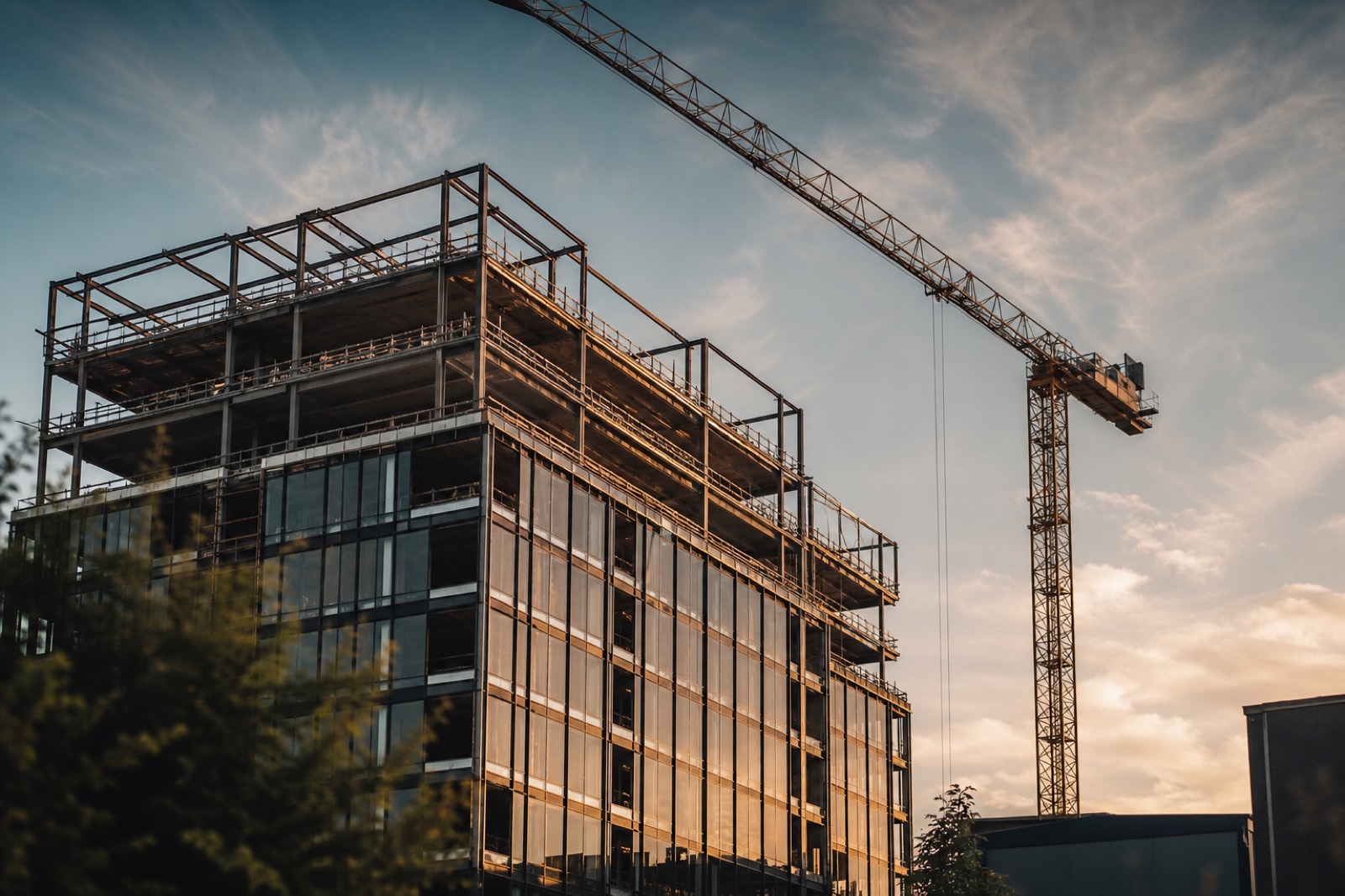
Commercial property development finance in Bradford funds the land purchase and construction of commercial schemes, from a single conversion to a multi-phase regeneration. We arrange it across West Yorkshire for developers, investor-developers and operators, structuring the debt and equity a scheme needs and placing it with the lenders that actually back that asset class.
We underwrite a Bradford scheme on its commercial fundamentals, with the local residential market as a gauge of exit liquidity for any residential element. That market is active and liquid, around 3,133 residential sales in the past year at a £156,000 median, which helps test the values for the homes in a mixed-use or conversion scheme.
We arrange the whole capital structure for Bradford commercial schemes. Senior development finance funds the bulk of the build, typically to 65 to 70 percent of cost and 60 to 65 percent of gross development value. Stretch senior and mezzanine finance lift leverage when the appraisal supports it, reducing the equity you commit. JV equity fills the remaining gap for developers scaling beyond their own balance sheet. For operational schemes that let up or trade after completion, such as student accommodation, care homes, hotels or self-storage, stabilisation finance carries the asset from practical completion through to stabilised income. Once the scheme is stabilised or sold, development exit finance refinances it onto cheaper money while units sell or let, releasing equity for the next site in West Yorkshire.
Each commercial asset class is underwritten on different tests by different lenders, and we arrange finance for all of them in Bradford and across West Yorkshire. That covers student accommodation and offices, warehouses and logistics, care homes and healthcare, retail, hotels and leisure, industrial and mixed-use schemes, and the higher-growth classes of self-storage, data centres and life sciences. Knowing which lender backs which sector here, and at what leverage, is the work we do before a scheme ever reaches a credit committee.
Bradford is a regeneration market within West Yorkshire, where lower current values mean the scheme's end value and the strength of local demand carry the appraisal. These markets reward developers who can evidence demand, and lenders often look for a clear exit or pre-sale before stretching leverage.
Bradford carries a £156,000 median sale price across 3,143 transactions in the trailing twelve months, with prices up 3.3% year on year. That makes it the lowest-cost city in mainland UK by median, but volume tells the more useful story for developers: trading is broad and liquid in the £80,000 to £250,000 band where most stock changes hands. The terraced median sits at £125,000 and flats at £82,000, so any scheme that lands a finished unit between £150,000 and £200,000 is selling into the deepest part of the local market. The demographic story is unusually strong for a northern core city. Bradford is the youngest city in the UK, with roughly a quarter of the population under 16, and household formation is rising faster than housing delivery. The UK City of Culture 2025 programme has pulled hospitality, public realm and tenant covenant interest into the city centre, but the spillover into resi values has been measured rather than dramatic. Developers are using the cultural narrative to underwrite letting demand and exit speed, not headline price growth.
Sold-price evidence backs the conversion thesis. A detached at 52 Plantation Drive, BD9 sold for £378,000 on 27 March 2026, and 7 Ridings Croft, BD5 transacted at £352,000 on 20 March, marking the upper end of family-house demand in the better suburban postcodes. The middle of the market is where most schemes will exit: 14 Kingston Grove, BD10 (semi, £215,000), 83 Watty Hall Road, BD6 (semi, £250,000) and 21 Anne Street, BD7 (terrace, £175,000) are typical of the £150,000 to £250,000 band that absorbs finished refurbished stock quickly. At the lower end, 129 Spring Mill Street, BD5 at £80,000 and 16 Burton Street, BD4 at £85,000 show the buy-cheap entry points that drive HMO and small landlord activity. New-build sales sit at a 54.8% premium to existing stock, which on paper looks generous, but with only 50 new-build transactions in 12 months against 3,093 existing-stock sales, that premium is being captured by a small number of schemes.
This residential mix is exit context for the homes within a mixed-use or conversion scheme. It is not a guide to commercial values, which are sector and covenant driven.
| Detached | £299,000 |
| Semi-detached | £184,950 |
| Terraced | £125,000 |
| Flat / apartment | £82,000 |
Source: HM Land Registry residential price-paid data, last 12 months.
| Quarter | Median | Sales |
|---|---|---|
| 2024-Q2 | £140k | 1165 |
| 2024-Q3 | £150k | 1241 |
| 2024-Q4 | £154k | 1442 |
| 2025-Q1 | £155k | 1379 |
| 2025-Q2 | £145k | 990 |
| 2025-Q3 | £153k | 1105 |
| 2025-Q4 | £165k | 925 |
| 2026-Q1 | £162k | 544 |
Relevant planning activity recorded by City of Bradford, a read on competing supply and local development appetite.
Extension of an existing padel tennis facility into an existing vacant industrial unit next door.
View on the planning portal →Change of use of existing upper floor from Class E commercial use to form 1 no. self-contained 1-bedroom flat with ground floor remaining in commercial use
View on the planning portal →Replacement of existing timber framed double-glazed windows with new to the south gable elevation and part west elevation
View on the planning portal →A sample of recent residential transactions across BD7, BD6, BD2, BD9, BD10, exit context for the residential element of a scheme rather than a guide to commercial values.
| Address | Postcode | Type | Price | Date |
|---|---|---|---|---|
| 21, ANNE STREET | BD7 4RB | Terraced | £175,000 | 30 March 2026 |
| 2, COLLBROOK AVENUE | BD6 1HL | Semi-detached | £85,000 | 27 March 2026 |
| 62, PLUMPTON GARDENS | BD2 1PH | Detached | £175,000 | 27 March 2026 |
| 52, PLANTATION DRIVE | BD9 6SG | Detached | £378,000 | 27 March 2026 |
| 14, KINGSTON GROVE | BD10 8PE | Semi-detached | £215,000 | 27 March 2026 |
| 53, GRASLEIGH AVENUE | BD15 9AR | Semi-detached | £145,000 | 26 March 2026 |
| 129, SPRING MILL STREET | BD5 7HE | Terraced | £80,000 | 23 March 2026 |
| 83, WATTY HALL ROAD | BD6 3AH | Semi-detached | £250,000 | 23 March 2026 |
| 536, BEACON ROAD | BD6 3NA | Terraced | £183,000 | 23 March 2026 |
| 16, HARROGATE AVENUE | BD3 0LH | Terraced | £107,000 | 23 March 2026 |
For SME developers and landlords the Bradford brief writes itself. Low entry pricing makes conversion and refurbishment the dominant trade: terraces and semis bought in the £80,000 to £130,000 band, refurbished for £30,000 to £60,000 and exited or refinanced into the £150,000 to £200,000 owner-occupier or buy-to-let market, with bridging from 0.65% per month covering the works phase. The HMO trade is louder than the new-build trade right now, and the Carlisle Road and Little Horton Lane applications are early evidence of room-count scaling into BD5 and BD8. Small new-build schemes of five to fifteen units are viable but need careful land cost discipline: at a £156,000 median, senior development finance pricing at 9% to 12% and typical 65% to 70% LTGDV gearing only stacks where land is bought well and build costs are controlled. The market rewards operators who can deliver finished units below £200,000 quickly.
The Q2 2026 pipeline is small in count and revealing in shape. Four relevant applications are pending across our coverage, totalling 12 units and roughly £1.95m of estimated GDV, but three of the four are change of use rather than new build. The Carlisle Hotel scheme at 86 Carlisle Road, BD8 (26/01529/FUL) proposes converting a public house and existing 10-bed HMO into an 18-bed HMO, the clearest signal in the pipeline that operators are scaling licensed HMO rooms in inner Bradford rather than chasing flat conversions. A second HMO application at 153 Little Horton Lane, BD5 (26/01393/FUL) seeks retrospective consent for an 8-bed C4 HMO, underlining how much of the working pipeline is being delivered ahead of paperwork. The only meaningful new-build site is Land Adjacent Havelock Street (26/01644/PIP), a permission-in-principle for nine dwellings, eight three-bed semis and one four-bed detached, with an estimated GDV of around £1.62m. A small upper-floor commercial-to-resi conversion at 583 Halifax Road (26/01455/FUL) adds two flats. The composition is consistent with what brokers are seeing across underwriting: bridging-to-refurb and small-scheme development finance, not headline regen.
We expect Q3 and Q4 2026 pipeline to stay weighted toward change of use and small-site infill rather than large allocations, with HMO activity continuing to outpace new-build starts. City of Culture residual benefit through 2026 should support letting demand and tenant covenant in BD1, BD7 and BD8 rather than headline values. The risk to watch is HMO licensing tightening at council level as the room-count trade scales. The opportunity is clear: Bradford remains one of the few UK markets where a careful refurbishment or conversion can still hit a sub-£200,000 exit on a sub-£150,000 all-in cost, and that maths is keeping the pipeline alive even at modest GDVs.
Bradford is where the small-scheme conversion trade still stacks, because nowhere else gives you a £156,000 exit on a £100,000 entry.
Most senior lenders fund up to 65 to 70 percent of total cost, capped at 60 to 65 percent of gross development value, with stretch senior or mezzanine lifting that toward 85 to 90 percent of cost on a strong scheme. The Bradford exit market, currently active and liquid, informs the gross development value a lender will accept.
We hold more than one hundred lender relationships across banks, challenger banks, debt funds and private capital. The right lender for a Bradford scheme depends on the sector, the leverage you need and your track record, and we shortlist the desks most likely to back it across West Yorkshire.
It matters mainly as exit context for the residential element of mixed-use, build-to-rent and conversion schemes. HM Land Registry records a £156,000 residential median in Bradford over the past year across roughly 3,133 sales, with flats around £82,000. Commercial values, by contrast, turn on covenant, yield and sector demand, which we assess scheme by scheme.
Yes. We arrange commercial property development finance across the whole of West Yorkshire and the wider UK, with the same approach: model the capital stack, match the scheme to the lenders that back its sector, and negotiate terms on the developer's behalf.
Send us the outline and we will come back with a view on fundability and likely terms within one working day.